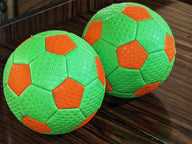

Sialkot
Sialkot and football making: a short history

A short, sourced history of Sialkot's football trade, from an 1889 origin story and the 1997 Atlanta Agreement on child labour to the rise of machine-made balls.
Cricket is Pakistan's great sporting passion, yet Sialkot has been making footballs for more than a century. A 2016 paper by economist David Atkin and colleagues called the city the world centre of hand-stitched ball production, and a puzzle in a country where football draws far less interest. Here is how it happened.
A garrison city and a saddle-maker
According to the 2016 paper, the British set up a large military garrison in Sialkot in 1852, and local craftsmen skilled in leather were well placed to serve football-playing soldiers. The origin story they cite, from Iqbal Sandal's self-published history of the city's ball trade, is set in 1889. A British sergeant took a ball with dried-out leather to a saddle-maker, Fazal Elahi, who took it apart, used it as a pattern and made a new one. Spared the usual eight-month wait for a replacement from England, the sergeant ordered six more and introduced Elahi to other regiments. Several of Elahi's apprentices later opened firms of their own.
Other sources differ. A 2018 cluster profile by the government's Small and Medium Enterprises Development Authority (SMEDA) traces the sports goods trade to an 1883 factory making wooden goods such as cricket bats for British soldiers, and dates football manufacturing to 1918. A 1999 ILO evaluation report puts the start of ball stitching as early as 1906.
From garrison towns to exports
Drawing on the colonial district gazetteer, Atkin and colleagues describe Sialkot traders touring garrison towns across India, mending balls at first and later selling balls made in Sialkot. The First World War opened up exports: English ball production fell away, and Sialkot firms filled the gap by selling to other colonies. As a result, the city's firms already had customers abroad when most British residents left at Independence in 1947. Partition also changed ownership. SMEDA records that most factory owners, who were Hindu, moved to India, and that craftsmen, mostly Muslim, took over the businesses and expanded them.
Growth, and a reckoning in the 1990s
Firm owners interviewed for the 2016 paper partly credited government export rebates, offered from the early 1970s to the mid-1990s, for later growth. Citing the State Bank of Pakistan, Dawn's Aurora magazine reported in 2022 that Sialkot firms had made match balls for a major international tournament since its 1982 edition. A July 2026 LUMS Centre for Entrepreneurship article says only that a ball made in Pakistan was used at "nearly every" edition since then, and a December 2022 Reuters report carried by Dawn said that year's match balls were made in China.
Behind that success was a problem. The ILO's 1999 evaluation says that before its project began in 1997, stitching was mostly done at home by families, children included. A 1997 ILO statement put the district's share of the world's hand-stitched balls made for export at close to 75 percent, and cited an ILO study estimating that up to 7,000 children worked in the trade.
The Atlanta Agreement
On 14 February 1997, the ILO, UNICEF and the Sialkot Chamber of Commerce and Industry signed an agreement in Atlanta to end child labour in the city's ball industry. Stitching moved out of homes into registered centres open to inspection. The 1999 evaluation reports that 56 companies, with 75 percent of Pakistan's production capacity, had opened their centres to ILO monitors, and that more than 5,000 children in the district had gained access to non-formal education. It was frank about the costs: women lost work and families lost income when stitching left the home, and home-based stitching was later reintroduced through 467 monitored village centres employing more than 2,000 women. The LUMS article credits the agreement with winning back the trust of international buyers.
Stitching moved out of homes into registered centres open to inspection.
Hands, machines and heat
SMEDA's 2018 profile described ball making as resting mostly on craftsmen's manual skill and estimated that Sialkot met around 60 percent of world demand for hand-stitched inflatable balls, about 39 million a year. Aurora put the share at about 70 percent in 2022. SMEDA also warned that machine-made balls were a serious threat. Atkin and colleagues had already described a gradual contraction from the mid-1990s as machine-stitched balls, typically made in China, took market share. In 2018, Dawn reported that a Sialkot firm moved in 2013 to thermo-bonded balls, which rely on heat, not thread, to hold their panels together.
The LUMS article, which draws on interviews with manufacturers, says hand-stitched balls made up 80 to 90 percent of the city's output five or six years before it was published, against about 20 percent in 2026. At one manufacturer it describes, a worker makes about five balls a day by hand and about 70 by machine. The 2022 Reuters report cited the local chamber of commerce: Sialkot produced over 43 million balls, worth $191 million, in 2021-22.

What this means when you buy a ball
- "Made in Sialkot" covers many kinds of ball. Hand-stitched, machine-stitched and heat-bonded balls all come from the city today, so ask how a particular ball is made.
- Buyers' questions matter. The ILO evaluators found that many manufacturers joined the monitoring programme because foreign importers asked for proof. Schools, clubs and academies ordering in bulk can ask suppliers how their workers are treated.
- Know the rules. Law 2 of the IFAB's Laws of the Game requires a ball 68 to 70 cm in circumference, weighing 410 to 450 g at the start of the match and inflated to 0.6 to 1.1 atmosphere at sea level.
Sports Sialkot on Khawaja Safdar Road
As our About page explains, some of our range comes from our own workshop and some from specialist makers nearby. We currently sell four size 5 footballs, in our footballs collection, with cash on delivery and a flat Rs 250 delivery charge within Pakistan. For size 3 or 4, message us on WhatsApp at +92 300 145 3645 and we will see what we can do. Clubs, schools and academies can ask for a bulk quote through our contact page or on WhatsApp at +92 300 145 3645.
Sources
- Atkin et al., On the Origins and Development of Pakistan's Soccer-Ball Cluster, World Bank Economic Review (2016)
- SMEDA, Cluster Profile: Sports Goods, Sialkot (2018)
- ILO, Sialkot partnership agreement text (1997)
- ILO, Sialkot child labour project evaluation report (1999)
- Aurora (Dawn), The Sialkot Cluster (30 December 2022)
- Dawn, report on Sialkot's football makers (4 February 2018)
- Reuters via Dawn, report on Sialkot's ball industry (9 December 2022)
- LUMS Centre for Entrepreneurship, Stitching the World's Game (24 July 2026)
- The IFAB, Laws of the Game, Law 2: The Ball
Every football we sell is a size 5.
Match and training balls. Cash on delivery across Pakistan.