
Buying guide
Match ball or training ball: how to choose
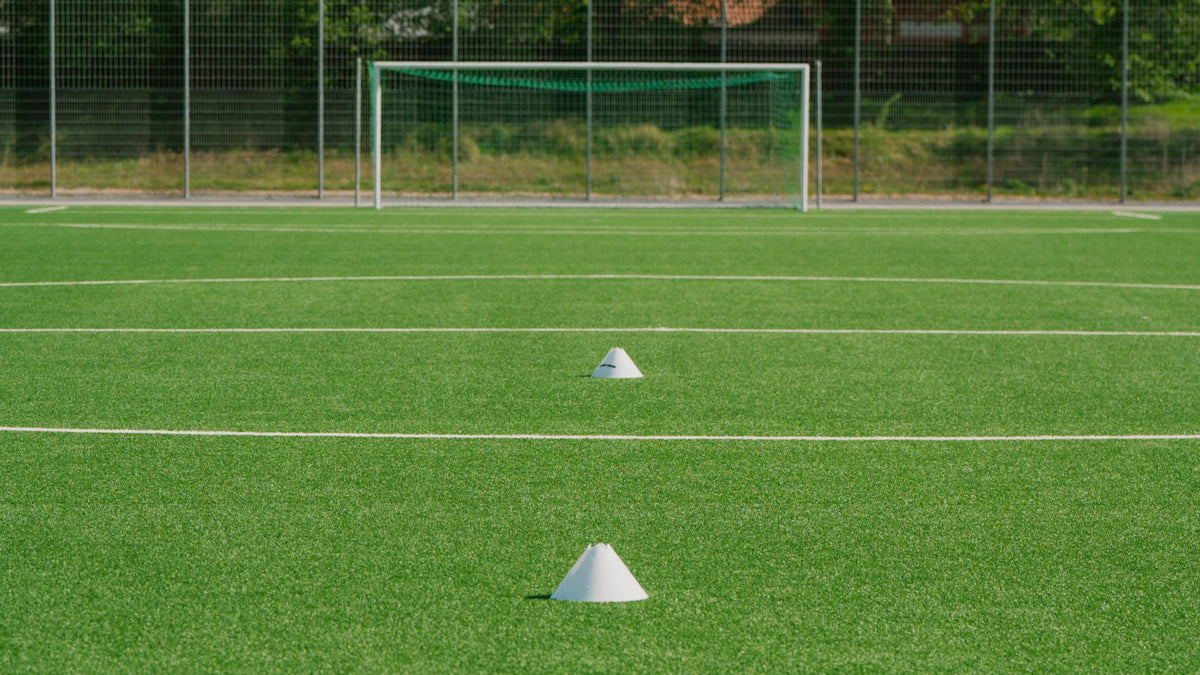
Match ball or training ball? Choose by how often the ball is used, the surface you play on, who uses it and how many balls your squad needs.
Many footballs are sold as either match balls or training balls, but the difference is not always obvious from the label alone. The right choice depends less on the label than on the life the ball will lead: how often it is kicked, what it is kicked on, and by whom. Here is how to decide, whether you are a player, parent, coach or school in Pakistan.
What the two labels mean
Law 2 of the IFAB's Laws of the Game sets out what a ball has to be: spherical, made of suitable material, 68 to 70 cm in circumference, 410 to 450 g at the start of the match, and inflated to 0.6 to 1.1 atmospheres at sea level. The match and training labels describe something else: the job a ball is made for.
UK kit suppliers put it simply. A training ball is meant to cope with months of heavy practice, often on whatever surface is available. A match ball is meant for the shorter, more intense demands of a game. Our own range is organised the same way: our match footballs are intended for club matches, friendlies and weekend football, and our training football for practice sessions and drills.
1. How often will the ball be used?
A ball that comes out for drills most evenings and goes straight back into a kit bag is doing training work, whatever is printed on it. Suppliers point training balls at that kind of routine and keep match balls for competitive games. If a ball will mainly come out for a weekly fixture on a proper pitch, a match ball makes sense.
The match and training labels describe something else: the job a ball is made for.
2. What surface will you play on?
One UK kit supplier names grass, artificial turf, concrete and indoor halls as ordinary places to train, and describes match balls as suited to grass. Both suppliers say training balls are made for a mix of surfaces. If your regular game is on a bare school ground, a cemented courtyard or a street, treat that as training use and save match balls for a proper pitch on match day.
3. Who will use it?
Young children. Get the size right before worrying about the type. In England Football's guidance, children from under-7 to under-11 play with a size 3 ball, under-12s and under-13s move up to size 4 with 9v9 as their largest format, and size 5 arrives with 11v11 at under-14. Other leagues and schools may differ, so ask what yours uses. Our current range is size 5 only. If you need size 3 or size 4, message us on WhatsApp at +92 300 145 3645 and we will tell you what we can do.
A teenager or adult buying one ball. For everyday practice, a training ball is the natural first buy. If you also play organised games and your team does not supply the ball, a second one kept only for matches is a sensible addition.
Coaches and academies. The number of balls matters more than the label. Players waiting in a queue for one ball are not practising.
Schools. A ball passed around PE lessons all week, especially on hard ground, is doing training work. Keep a smaller, separate set for inter-school fixtures.
4. How many balls does a squad need?
The US Youth Soccer coaching manual links ball numbers to age. It makes a ball for every under-6 player a requirement, and says under-8s should share one between two. It treats four under-10s sharing a ball as acceptable, and eight under-12s to a ball as suitable, on the basis that fewer balls per player pushes children towards more abstract thinking. Even so, its typical under-8 session opens with a warm-up in which every player has a ball.
To set your own budget, start from your biggest regular group and the most ball-hungry part of the session. Sixteen under-8s working in pairs need eight balls; a one-ball-each warm-up for the same group needs sixteen. Cover that with training balls, add a spare or two, then budget for a small match set separately so match balls are never borrowed for practice.
Keep match balls for match day
- Label your match balls and keep them in their own bag so they do not drift into training.
- Law 2 allows extra balls that meet its requirements to be placed around the field, with the referee controlling their use, so take a spare to fixtures.
- Inflate to the pressure marked on the ball and do not go over it. Balls gradually lose air over a few days, so check them before each session or game.
- After a wet or muddy outing, clean the ball with lukewarm water and a little mild soap, then let it dry naturally, away from heaters and direct sun.
- Store balls somewhere dry at room temperature, not in a car boot that can get very hot or cold. For long breaks such as school holidays, let some air out, but do not store them completely flat.
- Do not sit on a football, as it can be pushed out of shape.
A quick way to decide
- Used several times a week, on hard or mixed ground, or shared by a group: browse our training footballs.
- Kept for organised games on a proper pitch: browse our match footballs.
- Kitting out a team, academy or school: cover your busiest session with training balls first, then add a separate match set.
Buying for a club, school or academy
For squad or school orders, ask us for a bulk quote through our contact page or on WhatsApp at +92 300 145 3645, and we can help with the mix. Cash on delivery is available on orders within Pakistan, and delivery within Pakistan is a flat Rs 250 per order. You can request a return within 30 days of receiving an item as long as it is unused, with its tags and original packaging, and you have proof of purchase. Custom items, sale items and gift cards cannot be returned (see our refund policy). Part of what we sell is made in our own workshop and part by specialist makers around us in Sialkot.
Sources
- The IFAB, Laws of the Game: Law 2, The Ball
- England Football, FutureFit: ball sizes for different age groups
- US Youth Soccer coaching manual (PDF)
- Pendle Sportswear: training vs match footballs
- Kit King: training ball vs match ball
- Soccer Command: how to care for your soccer ball
- Sports Sialkot FAQ
- Sports Sialkot: About us
- Sports Sialkot shipping policy
- Sports Sialkot refund policy
- Featured photo: Max Zindel on Unsplash
Every football we sell is a size 5.
Match and training balls. Cash on delivery across Pakistan.